
Med Spa No-Show Math: How to Calculate Lost Revenue Per Campaign
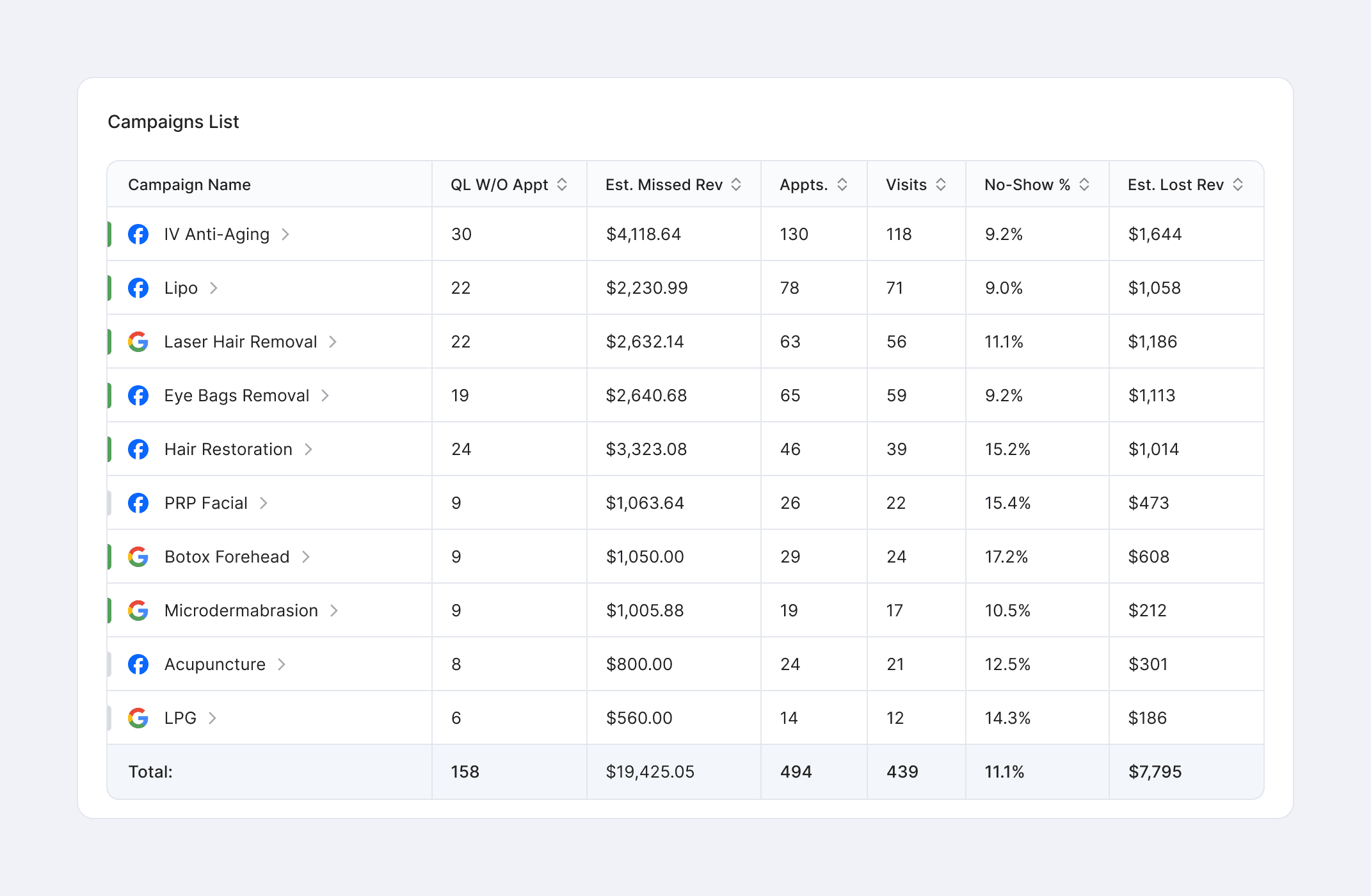
Your ad report says the campaign performed well. Your bank balance disagrees.
This gap — between what marketing metrics show and what actually hit the account — is one of the most common and most frustrating experiences in med spa marketing. The campaign generated leads. Some booked. The dashboard looks healthy. But the revenue isn’t there.
A large part of that gap is no-shows: booked appointments that never became visits. Most clinics know no-shows hurt. Very few have ever put a precise dollar figure on what they’re costing — per campaign, per month.
That number matters more than almost any other metric, because it answers a question that determines where you focus: is your revenue leaking because of your ads, or because of what happens after the lead arrives?
This article walks through exactly how to calculate lost revenue from no-shows per campaign, what the number reveals, and how to use it to fix the right problem instead of guessing.
The Question This Calculation Actually Answers
Before the math, it’s worth being clear about why this matters — because med spa owners don’t actually want calculations. They want answers to specific, frustrating questions:
- Why is revenue lower than the ad reports suggest it should be?
- Which campaign is quietly wasting money?
- Should I cut Meta?
- Should I push back on my agency?
- Is my front desk dropping the ball?
The no-show calculation answers the one question underneath all of these: is this an ad problem or an operations problem?
That’s the real value here. The math is just the mechanism. The diagnosis is what changes your decisions — because the fix for an ad problem (different audience, different offer, different platform) is completely different from the fix for an operations problem (faster follow-up, better confirmation, deposits). Most clinics spend money on the wrong fix because they never isolated which problem they actually have.
Two Different Leaks: Missed Revenue vs. Lost Revenue
Before calculating anything, it’s worth distinguishing between two separate revenue leaks that often get lumped together. They have different causes and different fixes.
Lost revenue: leads that never became bookings. These are leads your campaign generated that never converted to a scheduled appointment. The patient inquired, then disappeared — never booked. The cause is usually either lead quality (the ad attracted low-intent prospects) or follow-up failure (the lead wasn’t contacted fast enough or persistently enough).
Missed revenue: bookings that never became visits. These are patients who booked an appointment and then didn’t show up. The cause here is different — confirmation workflow, commitment level, reminder systems, or the type of patient a campaign attracts.
Both are revenue leaks. Both trace back to specific campaigns. But the fix for lost revenue (better lead quality or faster follow-up) is completely different from the fix for missed revenue (better confirmation, deposits, reminder sequences, commitment-building).
Calculating them separately is what lets you diagnose precisely instead of vaguely concluding “the campaign underperformed.”
The No-Show Revenue Formula Every Med Spa Should Know
The calculation can be done at three levels of sophistication. Start simple, then refine.
Level 1 — Simple estimate:
(Booked appointments that didn’t show) × (average treatment value)
Level 2 — Better estimate (accounts for conversion):
(No-shows) × (consultation-to-treatment conversion rate) × (average treatment value)
This is more accurate because not every patient who showed would have purchased — applying your conversion rate gives a truer picture of the revenue actually at risk.
Level 3 — Lifetime value estimate:
(No-shows) × (average patient lifetime value)
This captures the real cost, since a no-show isn’t just one missed treatment — it’s a patient relationship that never started (more on this below).
A worked example:
- A Facebook campaign generated 50 leads
- 30 booked consultations
- 12 didn’t show up
- Average treatment value: $650
Immediate missed revenue: 12 × $650 = $7,800 — from one campaign, in one month.
Now apply lifetime value. If your average patient is worth $2,400 over their relationship with the clinic:
Potential lifetime revenue lost: 12 × $2,400 = $28,800.
That’s the real figure. The $7,800 is what you lost this month. The $28,800 is what those relationships would have been worth if they’d started.
For lost revenue (leads that never booked), the parallel calculation is:
(Leads that never booked) × (typical booking-to-treatment rate) × (average treatment value)
This one is more of an estimate, since not every lead would have converted. But applying your normal conversion rate to the unbooked leads gives you a reasonable figure for what that campaign’s unconverted leads represented.
A note on interpretation: Not every no-show would have become revenue. Some patients were never serious. Some would have canceled regardless. The purpose of this calculation isn’t perfect forecasting — it’s prioritization. If one campaign is leaking 5x more revenue than another, that’s the signal that matters, regardless of whether the absolute numbers are precise.
Why Most Med Spas Never Calculate This Number
Most clinics evaluate campaigns on cost per lead, click-through rate, or lead volume. Those metrics describe the top of the funnel. They say nothing about whether the booked revenue actually arrived.
When you can attach a dollar figure to the no-show leak per campaign, several things change:
You stop guessing about blame. Without the number, a campaign that “underperformed” gets blamed on whatever feels most plausible — usually the ads or the agency. With the number, you can see whether the leak was in lead conversion (lost revenue) or in show rate (missed revenue).
You can prioritize by dollar impact. If Campaign A has $7,800 in missed revenue and Campaign B has $800, you know where to focus first.
You can justify operational investment. “We should improve our confirmation process” is a weak argument. “We’re losing $7,800 a month in missed revenue on this one campaign, and a deposit requirement could recover most of it” is a decision.
The Campaign Comparison That Changes Budget Decisions
Here’s where this gets powerful. Consider three campaigns side by side:
| Campaign | Leads | No-Shows | Missed Revenue |
|---|---|---|---|
| Google Botox | 18 | 3 | $1,950 |
| Meta Filler | 44 | 12 | $7,800 |
| Facial Promo | 61 | 18 | $5,400 |
The Facial Promo generated the most leads — by a wide margin. On a cost-per-lead basis, it probably looks like your best campaign. But it’s also producing the second-largest revenue leak, and the Meta Filler campaign is leaking the most of all.
Without this analysis, you might increase budget on the Facial Promo because its CPL looks great — pouring more money into a campaign that’s bleeding revenue downstream. With it, you can see that your no-show leak is concentrated in specific campaigns, and that lead volume and revenue leak are not the same thing.
Build a Revenue Leak Leaderboard
The most actionable version of this is a monthly ranking. For each campaign, calculate both leaks and total them:
| Campaign | Lost Revenue | Missed Revenue | Total Leak |
|---|---|---|---|
| Meta Filler | $3,200 | $7,800 | $11,000 |
| Facial Promo | $2,200 | $5,400 | $7,600 |
| Google Botox | $900 | $1,950 | $2,850 |
Now you know exactly where to focus. The Meta Filler campaign is your largest revenue leak — $11,000/month between unbooked leads and no-shows. That’s where operational and campaign attention should go first, regardless of what its CPL looks like.
Ranking campaigns by total revenue leak each month turns a vague sense that “something’s off” into a prioritized action list.
Why Your Agency Can’t Show You This Number
There’s a structural reason most clinics have never seen this analysis: their agency can’t produce it.
Your agency can tell you impressions, clicks, CPL, and platform ROAS. What they usually can’t tell you is which booked appointments never showed, which campaigns generated those no-shows, and how much revenue disappeared as a result.
That’s not an agency failure. It’s a data access issue — the answer lives inside your booking system and EMR, not your ad platform. The agency only sees up to the lead. Everything past that — booking, show, treatment, revenue — happens in systems they don’t have access to. Which means the most important number for evaluating a campaign’s true performance is structurally invisible to the people managing your campaigns.
Ad Problem or Front Desk Problem? The Diagnostic
The most valuable thing the no-show calculation reveals is where the leak is. Here’s how to read it.
If lost revenue is high (many leads never booked): The leak is between lead and booking. This is either a lead quality problem (the campaign attracted low-intent prospects) or a follow-up problem (leads weren’t contacted fast or persistently enough).
To distinguish: check response time for that campaign’s leads. If follow-up was slow, that’s your answer. If follow-up was fast and consistent but leads still didn’t book, the campaign is attracting the wrong audience.
If missed revenue is high (many booked but didn’t show): The leak is between booking and visit. This is a confirmation, commitment, or reminder problem — or a sign the campaign is attracting low-commitment patients.
To distinguish: compare this campaign’s no-show rate to your clinic average. If it’s dramatically higher than other campaigns, the campaign itself is attracting low-commitment patients (often a sign of discount-driven offers). If it’s roughly in line with other campaigns, the problem is your general confirmation/reminder process, not this specific campaign.
If both are high: You have leaks at multiple stages, and the campaign needs both operational attention (follow-up, confirmation) and a closer look at lead quality (audience, offer).
This diagnostic is the entire point of the calculation. “The campaign underperformed” is not actionable. “This campaign has a 40% no-show rate vs. our 18% average, which means it’s attracting low-commitment patients, costing us $4,500/month” is a specific problem with a specific fix.
The Hidden Cost: It’s Not Just One Visit
The per-campaign no-show calculation captures the immediate missed revenue. But the true cost is larger, because a no-show isn’t just one missed appointment — it’s a missed patient relationship.
If your average patient visits 3 times a year and stays for 2 years at a $450 average ticket, a single patient who no-shows and never reschedules doesn’t represent $450 in lost revenue. They represent potentially $2,700 in lifetime value — the visits that would have followed the first one.
This is why no-show reduction is more financially significant than the first-visit math suggests. Each recovered no-show isn’t just one treatment. It’s the start of a patient relationship that, in a business with 73% repeat rates, generates most of its value over time rather than at first visit.
This is why a no-show isn’t merely an empty appointment slot. It’s a patient relationship that never started — and in aesthetics, the relationship is where nearly all the value lives.
When you calculate the cost of no-shows, the first-visit figure is the floor, not the ceiling. The lifetime value lost is the real number — and it makes the case for fixing no-shows far more compelling than a single-visit calculation alone.
There’s also a cost that doesn’t show up in any revenue calculation: a no-show means an idle provider, a held slot that produced nothing, and a front desk that did the work of booking with nothing to show for it. The operational and morale costs are real even when they’re hard to quantify.
How to Calculate This for Your Own Campaigns
Here’s the practical process, whether you do it manually or with connected systems.
The manual version:
- Export ad data by campaign — leads generated per campaign for the period
- Pull booking data from your CRM — which of those leads booked, ideally tagged by campaign source
- Check visit records in your EMR — which booked patients actually showed and were treated
- Calculate per campaign: leads that never booked (lost revenue), and bookings that didn’t show (missed revenue)
- Multiply by average treatment value to get dollar figures for each leak, per campaign
This takes a couple of hours per month and requires that your lead source data is reasonably clean — that you can trace which leads came from which campaign through to the EMR. In many clinics, that traceability is the hard part, since UTM tags and source attribution often don’t survive the journey into the booking system and EMR.
The reality of manual tracking:
Most clinics attempt this analysis exactly once. It requires ad reports, CRM exports, EMR records, and spreadsheet matching across all three. Three hours later, they have an answer for one month — usually an alarming one. Then they never repeat it, because the process is too painful to do monthly.
The biggest challenge is matching leads to bookings to visits across three systems that don’t talk to each other. UTM tags and source attribution often don’t survive the journey from the ad platform into the booking system and EMR — which means even the manual version requires detective work to reconstruct which lead came from which campaign. Even a rough version is more useful than no version. But “useful once and then abandoned” is the typical outcome, which is why most clinics are flying blind on this number despite knowing it matters.
How Revenue Leak Data Changes Budget Decisions
Calculating the cost is only useful if it changes a decision. Here’s how to act on it.
If a campaign has high missed revenue (no-shows):
- Implement or strengthen confirmation sequences for that campaign’s bookings
- Consider deposit requirements for high-ticket consultations
- Add reminder retargeting in the 48 hours before appointments
- If the no-show rate is dramatically above average, examine whether the offer is attracting low-commitment patients
If a campaign has high lost revenue (unbooked leads):
- Audit follow-up speed for that campaign’s leads specifically
- Check whether the campaign’s audience and offer match genuine treatment intent
- Test faster, multi-touch follow-up before concluding the campaign is bad
Across all campaigns:
- Rank campaigns by total revenue leak (lost + missed) and address the largest first
- Track the number monthly to see whether your fixes are working
- Use the trend, not a single month, to evaluate whether operational changes are reducing the leak
One Question to Ask Yourself
Which campaign created the most no-show revenue loss last month?
If you don’t know the answer, you’re making budget decisions without seeing one of the largest leaks in your marketing system. You might be increasing spend on a campaign that looks efficient by CPL while it quietly loses more revenue to no-shows than any other campaign you run.
That’s the gap this calculation closes.
The Bottom Line
In med spa marketing, the gap between what your ad report shows and what your bank account shows is usually hiding in two places: leads that never booked, and bookings that never showed.
Both are measurable. Both trace to specific campaigns. And the dollar figures, once you calculate them, almost always reveal that the problem you assumed (bad ads) is partly or entirely a different problem (slow follow-up, weak confirmation, or low-commitment patients from a specific offer).
Stop guessing whether it’s your ads, your agency, or your front desk. Calculate the missed and lost revenue per campaign, read where the leak actually is, and fix that specific thing. Clarity is what turns a vague sense that “marketing isn’t working” into a specific, solvable problem.
Want to See Your Missed and Lost Revenue Automatically?
Calculating no-show revenue manually takes hours and breaks down the moment your lead source data gets messy. ClinicROI connects your ad campaigns, bookings, and visit records — and shows estimated missed revenue (booked but no-show) and lost revenue (leads that never booked) by campaign, automatically.
Related articles: