Marketing
Med Spa Lead Form Ads vs. Landing Page Ads: Which Converts Better?
Meta lead forms are cheaper and easier. Landing pages cost more but qualify better. Here's which actually produces paying med spa patients — and when to use each.

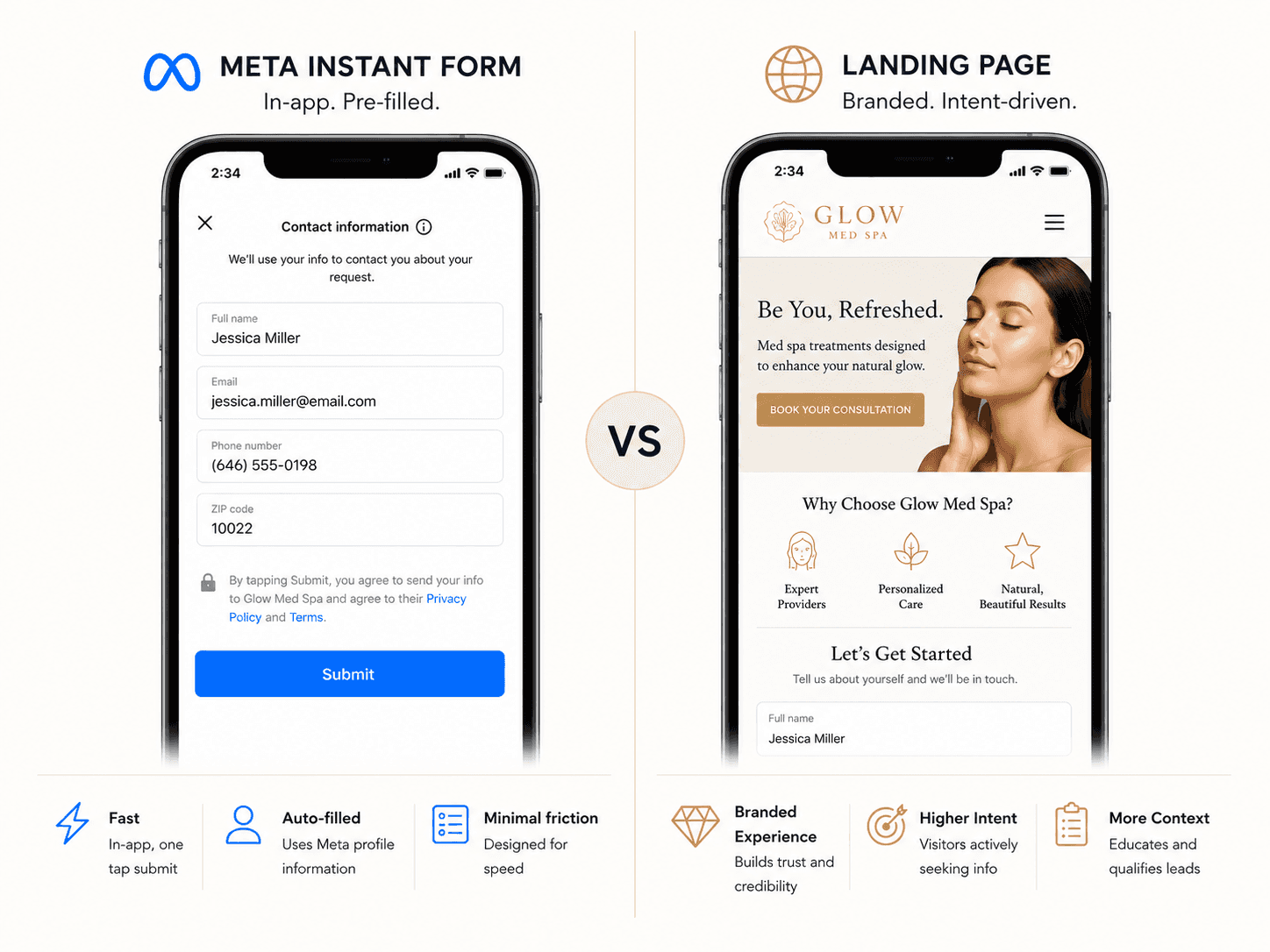
If you're running Meta ads for your med spa, you've faced this choice — maybe without realizing how much it affects your results.
When someone clicks your ad, where do they go? Two options:
Option 1: A Meta lead form (instant form). The form opens right inside Facebook or Instagram. Their name, email, and phone are pre-filled from their profile. Two taps and they've "submitted." Frictionless.
Option 2: A landing page. The click takes them out of the app to a dedicated page on your website. They read about the treatment, see your work, and fill out a form manually before booking.
The lead form is cheaper and produces more leads. The landing page costs more and produces fewer. So lead forms win, right?
Not necessarily — and the difference between "more leads" and "more patients" is exactly where most med spa ad budgets get misallocated. This article breaks down how each option actually performs through to booked, paying patients, and when to use which.
The Core Tradeoff: Volume vs. Intent
Here's the fundamental difference, stated plainly:
Lead forms maximize volume. Landing pages maximize intent.
A Meta instant form removes almost all friction. The person never leaves the app. Their contact info is auto-filled. They can submit in seconds, sometimes almost by accident, while scrolling. This produces a lot of leads at a low cost per lead.
A landing page introduces deliberate friction. The person has to click out of the app, wait for a page to load, read, and manually enter their information. Every one of those steps loses some people — which is exactly why the leads who make it through are more committed.
This is the entire tradeoff in one sentence: the friction that lowers your lead volume is the same friction that raises your lead quality. Lead forms remove it. Landing pages keep it. Neither is universally "better" — they produce structurally different leads.
Why "More Leads" Often Means "More Work, Same Revenue"
The seductive thing about lead forms is the CPL. You'll often see Meta instant form CPLs that are 40-60% lower than landing page CPLs. On the ad report, that looks like a clear win.
But CPL isn't revenue. Here's what the lower number often hides:
Lower booking rates. A lead who tapped a pre-filled form in two seconds has demonstrated far less intent than someone who read a full landing page and chose to fill out a form. When your team calls the instant-form lead, a meaningful share don't remember submitting, aren't seriously interested, or were just curious about a discount.
Lower show rates. The same shallow commitment that makes instant forms easy to submit makes those appointments easier to skip. Lead-form patients no-show at higher rates than landing-page patients in many clinics, because the emotional commitment was never that deep.
More follow-up labor. Because instant-form leads are lower intent, your front desk spends more time and more touchpoints converting each one to a booking — if they convert at all. The "cheap" lead consumes expensive staff time.
Put together: a campaign generating 90 instant-form leads at $22 CPL can easily produce fewer paying patients than a campaign generating 35 landing-page leads at $60 CPL. The lead form looks 3x more efficient on the ad report and may be less efficient on the revenue line.
This is the same trap covered in our breakdown of why cost per lead misleads med spa owners — the cheaper lead metric systematically hides downstream quality.
The Hidden Cost of Lead Forms
The lower CPL doesn't just hide lower quality. It hides a real operational cost most clinics never put on the books.
Consider two campaigns running the same offer:
Lead Form Campaign:
100 leads at $20 CPL
35 booked
22 showed
15 treated
Landing Page Campaign:
40 leads at $55 CPL
24 booked
20 showed
14 treated
On the ad report, the lead form is the obvious winner: 100 leads vs 40, $20 CPL vs $55. Any agency would point to that and recommend shifting budget to lead forms.
But look at what actually reached the chair: 15 treated patients vs 14. Nearly identical. The lead form generated 2.5x the leads to produce one additional patient.
And here's the part the report never shows: your front desk had to contact, qualify, and chase 100 leads instead of 40 to get there. You didn't buy more patients. You bought more work — 60 extra low-intent leads that consumed staff time and produced almost nothing.
That's the hidden cost. The lead form's "efficiency" is partly an illusion created by pushing cost off the ad report and onto your front desk.
The Front Desk Bottleneck Most Clinics Ignore
This connects to a constraint most med spas underestimate: your front desk has a finite capacity for following up well.
If your team can effectively manage 40 new leads per week — contacting each one fast, following up multiple times, handling them with care — then generating 100 lower-intent lead-form submissions doesn't help. It hurts.
Here's why: those 100 leads don't get the same quality of follow-up that 40 would. Response times slow down. Some leads get one touch instead of five. The good leads buried in the pile of low-intent ones get the same rushed treatment as the tire-kickers. Your booking rate on every lead drops because the team is spread thin.
More leads only helps if you have the capacity to work them well. Past that capacity, additional low-intent volume actively degrades performance — including on the leads that would have converted. A clinic that floods a capacity-constrained front desk with cheap lead-form volume can end up with fewer total bookings than if it had run fewer, higher-intent leads.
This is why "which converts better" can't be answered by the ad platform. The answer depends on your operational capacity, which Meta knows nothing about.
Where Lead Forms Actually Win
This isn't an argument against lead forms. They have real advantages and clear use cases:
Speed-to-lead is built in. Because the lead is captured instantly with verified contact info, your team can follow up within minutes — if you have the system to act on it fast. For high-volume offers where speed matters more than depth, this is genuinely valuable.
Mobile experience is seamless. The majority of Meta traffic is mobile. Landing pages that load slowly or render poorly on mobile lose people. Instant forms sidestep that entirely.
Volume for retargeting and nurture. If you have a strong email/SMS nurture sequence, a larger pool of lower-intent leads can be worked over time. Some convert later. The volume itself has value if you have the infrastructure to nurture it.
Lower-consideration services. For a $99 facial promo or a simple consultation offer, the depth of a landing page may be overkill. The decision is small; the friction isn't worth it.
The key requirement for lead forms to work: fast, persistent, multi-touch follow-up. A lead form without a strong follow-up system is a money-loser. The leads are shallow by design, so the follow-up has to do the work the landing page would otherwise have done. (This is the heart of the follow-up leak problem — lead-form campaigns are especially vulnerable to it.)
Where Landing Pages Actually Win
Landing pages earn their higher cost in specific situations:
High-ticket treatments. For body contouring, laser packages, or anything requiring real consideration, the landing page does essential work — explaining the treatment, showing results, building trust, and qualifying the patient before they ever reach your front desk. A $3,000 CoolSculpting decision isn't made through a two-tap form.
Qualification matters. A landing page can ask qualifying questions, set price expectations, and filter out bargain-hunters before they become a lead. This means fewer leads, but the ones you get are closer to ready. For a busy clinic where front desk time is the bottleneck, qualification is worth more than volume.
Show rate matters. Because landing-page leads invested more effort up front, they tend to show up more reliably. For clinics where no-shows are the primary leak, the landing page's higher commitment threshold directly protects the schedule.
Brand and trust building. A landing page is an opportunity to present your clinic — your providers, your results, your reviews. An instant form gives you none of that. For higher-consideration patients comparing multiple clinics, that presentation can be the deciding factor.
The Comparison Table
Factor | Lead Form (Instant Form) | Landing Page |
|---|---|---|
Cost per lead | Lower (often 40-60% less) | Higher |
Lead volume | Higher | Lower |
Lead intent | Lower | Higher |
Booking rate | Lower | Higher |
Show rate | Lower | Higher |
Follow-up labor required | High | Lower |
Qualification | Minimal | Strong |
Best for | Low-ticket, high-volume, strong nurture | High-ticket, qualification, show rate |
Mobile friction | None | Some |
The pattern: lead forms win at the top of the funnel (cost, volume), landing pages win at the bottom (booking, show, revenue). Which matters more depends entirely on what you're selling and where your bottleneck is.
Example: Same Offer, Different Funnel
Here's what the full picture often looks like when you measure both through to revenue:
Metric | Lead Form | Landing Page |
|---|---|---|
CPL | $24 | $58 |
Booking rate | 28% | 54% |
Show rate | 63% | 82% |
Cost per paying patient | $182 | $164 |
The lead form looked dramatically better in Meta — less than half the CPL. It performed worse in the clinic, where it actually mattered. The landing page cost more per lead and delivered patients more cheaply, because every stage after the click converted better.
If you'd made this decision on CPL alone, you'd have chosen the option that costs more per actual patient — and felt good about it, because the ad report told you that you were winning.
Which Treatments Work Better With Each?
Service type is one of the clearest signals for which approach to use.
Lead forms tend to work for:
Facial promos and introductory offers
Membership and package sign-ups
Seasonal specials
Lower-ticket, lower-consideration treatments where the decision is small
Landing pages tend to work for:
Botox and filler (where intent and rebooking matter)
CoolSculpting and body contouring (high consideration, high ticket)
Weight loss programs (longer decision cycle, recurring commitment)
Anything where qualification and trust-building affect conversion
The rough rule: the higher the ticket and the longer the consideration cycle, the more a landing page earns its higher cost. The lower and more impulsive the purchase, the more a lead form's frictionless volume makes sense.
How to Actually Decide — and Measure
The honest answer to "which converts better" is: you can't know for your clinic until you measure both through to revenue, not leads.
Here's the decision framework:
Default to landing pages if:
You sell mostly high-ticket treatments
Your front desk is already at capacity (you need qualification, not more volume)
No-shows are your biggest leak
You don't have a strong automated follow-up system
Default to lead forms if:
You sell mostly lower-ticket or introductory offers
You have fast, multi-touch follow-up infrastructure
You're building a nurture list for long-term conversion
Speed-to-lead is your competitive advantage
Test both if you can. Run the same offer through a lead form and a landing page simultaneously. But measure the right thing — not CPL, not lead volume, but cost per booked appointment, show rate, and cost per paying patient for each. The winner is almost never obvious from the ad platform's reporting, because the platform stops measuring at the lead.
This is the recurring theme across every channel decision in med spa marketing: the platform shows you the lead, but the revenue lives in your booking system and EMR. Comparing lead forms to landing pages on CPL alone will reliably point you toward the cheaper, worse option. (For the full framework on comparing Meta tactics by revenue, see Google Ads vs. Meta Ads for med spas.)
The metrics that actually decide it:
Metric | Tells you |
|---|---|
CPL | How cheap the lead was (least important) |
Booking rate | Whether the lead had real intent |
Show rate | Whether the commitment held |
Cost per paying patient | The real acquisition cost |
Revenue per patient | Whether they were worth acquiring |
ROI | Whether the campaign made money |
If you're only comparing the first row, you're making the decision with about 20% of the data — and it's the 20% most likely to mislead you.
Why Landing Pages Give You Better First-Party Data
There's one more advantage to landing pages that matters more every year: data ownership.
Lead forms keep most of the interaction inside Meta. You get a name, email, and phone — but little else, and limited ability to track what happens next. A landing page on your own site lets you capture analytics, fire your own tracking, build retargeting audiences, and connect the visit to your CRM and attribution systems.
As privacy changes continue to reduce what ad platforms can see and share, first-party data — the data you collect directly on your own properties — becomes more valuable. Landing pages build that foundation. Lead forms don't.
If revenue tracking and attribution matter to you — and for any clinic spending real money on ads, they should — landing pages provide a structurally stronger data foundation for connecting ad spend to actual patient revenue.
The Bottom Line
Most med spas choose lead forms because Meta makes them look better. Lower CPL. More leads. Cleaner reports.
The problem is that none of those metrics tell you whether patients actually showed up and paid — or how much staff time you burned getting them there.
Lead forms optimize for convenience. Landing pages optimize for commitment. The winner isn't the one that generates more leads. It's the one that generates more revenue after booking rate, show rate, treatment conversion, and front desk capacity are all accounted for.
That's why the real comparison isn't lead form vs. landing page. It's cost per paying patient vs. cost per paying patient. Measure both through to the chair, and the answer for your specific clinic stops being a debate and becomes a number.
Want to See Which Ad Type Actually Produces Patients?
Lead forms and landing pages look completely different on the ad report — and often reverse once you connect them to revenue. ClinicROI ties both back to booking data and EMR revenue, so you can see cost per paying patient and show rate for each, not just CPL.
Related articles: